Why only experience isn’t enough to change your life.
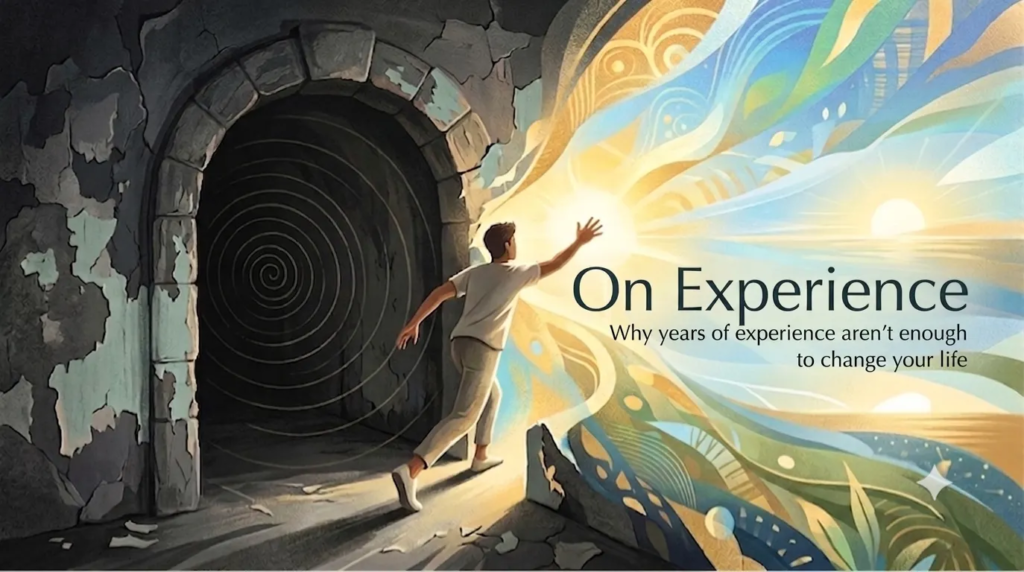
Experience is overrated. We think that what happened in the past will happen in the present the same way. The world is constantly changing. What worked or didn’t work before was subject to a particular time, place and circumstances—and numerous other factors. So, experience should inform you, not trap you in the past.
It’s also paradoxically true that the world isn’t changing. Many of the problems we face today, humans faced a thousand years ago too—entanglement in fear, greed, anger, exploitation, wars, restlessness, lack of peace etc.
Because the underlying human patterns aren’t changing across centuries, experiences of people who have deeply examined these patterns act as useful pointers for generations that follow. Though, everyone has to examine themselves to truly learn the lessons.
What you are today and the situations you find yourself in are the sum total of your attitude, actions, knowledge, skills and experiences. You’re naturally inclined to agree with theories or advice that resonate with your past. But all those factors don’t always stay the same. Hence, only experience, which is the past, isn’t enough, though useful.
If you only accept advice and theory that are an exact match of your mind and experience, you and your situations are going to be more or less the same. Only the surface or colours may change.
It’s like painting the prison wall with a different color.
A notable limitation of experience is rigid conclusions and generalisations. We have a tendency to reinforce our conditioning and biases. You mostly find what you’re looking for. The world can look like a projection of your mind. You experience one unpleasant thing and you rush to generalise it to all the people, an entire nation or even the world. Any individual’s experience is a very tiny part of everything happening in this vast world. So, being careful in generalisations is wise.
What should be your approach, then?
The first thing is observation. Observe, watch yourself directly—without rigid notions or ideology. It’s difficult because of our conditioning. Be aware of your lens or perspective at least when you’re looking at something. Your knowledge —what you think you already know— and your beliefs are impediments in your way to seeing “what is now”.
There is no substitute for self-awareness and observation in this world. It is the quality that empowers you to examine your own conditioning, overcome it and see beyond.
Science has been built on empirical observation, re-examination, falsification and negation— while using hypotheses, tools, and rigorous experimentation.
When you don’t have enough information to act in the present, experience remains useful. Act according to it and stay open to feedback and outcomes. Things can vary because of numerous other factors. See what happens this time.
Quality of experience matters more than duration of it.
One who lives with awareness, observes attentively, and learns continually can have the quality and depth in one year that others may develop in a decade. Focus on quality and depth, not only years. Awareness leads to maturity, not age.
Learn without accumulating. Don’t let every experience become a rigid belief. Do not be in a hurry to conclude and close. If you already have a conclusion—often it’s very subtle— you’re conforming to your biases.
Question and challenge your beliefs, and do the same with everything you’re told or everything you read. Actively note the underlying assumptions and blind spots. Learn to examine both agreements and disagreements. Think deeply and disagree reasonably.
Our allegiance is to truth, not to any ideology, concept, belief system or our biases.
When you approach everything with an open mind, it makes you more aware. Awareness, self-realisation and deep understanding bring change in your life—not accumulated knowledge, superficial experience or intellectual understanding.
Learn to entertain an idea (or a fact) without outright rejecting or accepting it. Entertain a series of hypotheses, experiment with them, and see what you find true and reliable. Revise your conclusions according to the evidence.
Observe. Learn. Change. Grow. Let the experience inform you, not close you in a box, repeating the same patterns.
Thank you for reading! Feel free to share your view.
-Sandeep

Leave a Reply